
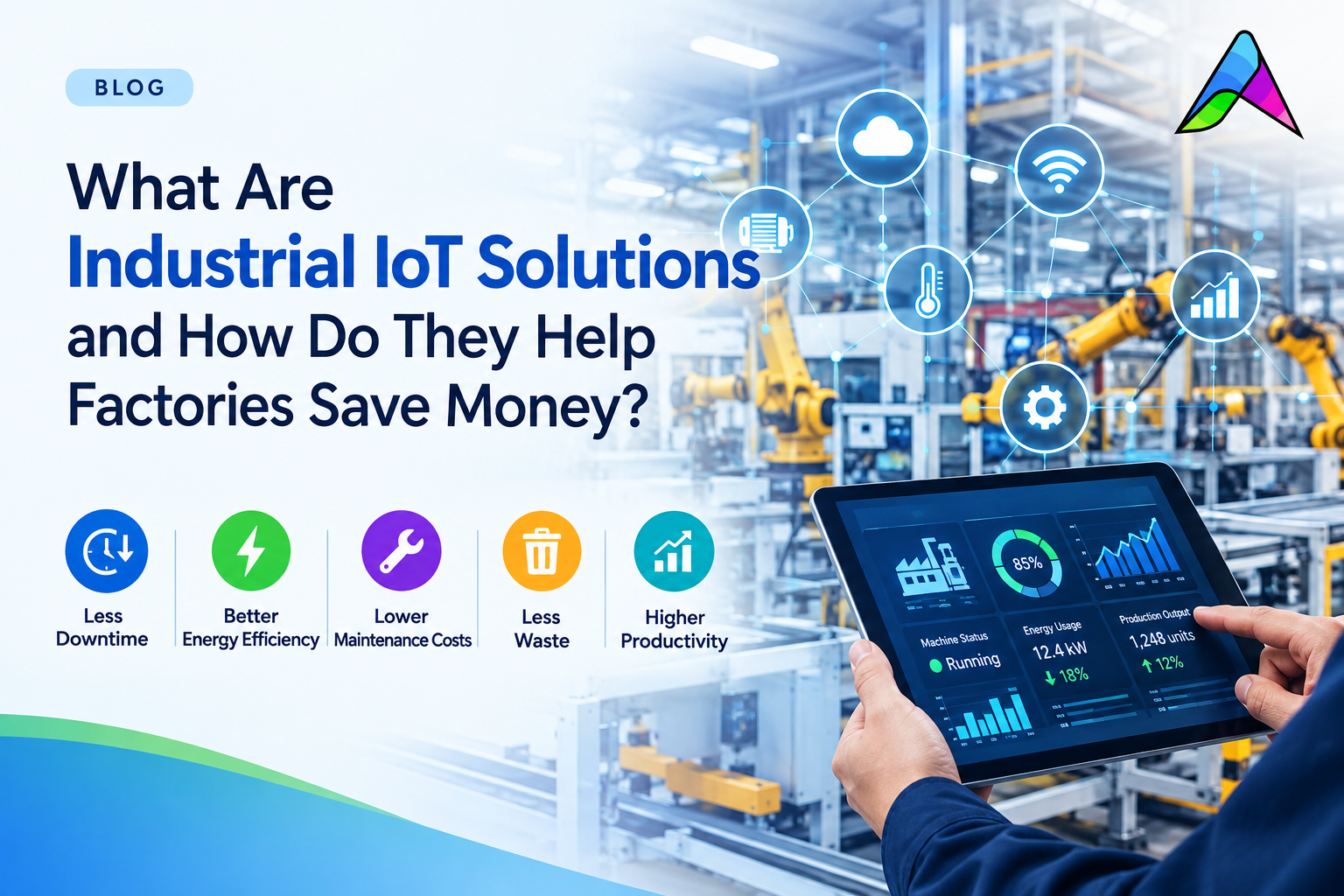
Energy bills, maintenance spend, and production costs keep rising for manufacturers across the country. Most plant managers sense that money is leaking somewhere on the shop floor, but without live data, it is hard to say where. This is why industrial IoT solutions in India are getting serious attention from factory owners. By connecting machines, sensors, and software, a plant can see what is happening on every line as it happens.
This guide explains what industrial IoT solutions are, how they reduce costs, where they fit in Indian factories, and how to choose the right partner.
What Are Industrial IoT Solutions?
The Industrial Internet of Things (IIoT) is the use of connected sensors, machines, and software inside industrial operations. Industrial IoT solutions bring these pieces together so a factory can collect data from its equipment, send it over an industrial network, and analyse it to support better decisions.
A typical industrial IoT platform has four layers. Sensors and meters capture readings such as temperature, vibration, current, and cycle counts. Gateways and industrial networks move that data securely. A software layer stores and analyses it. Dashboards and alerts then show the results to operators, engineers, and managers.
Common examples include:
- Equipment monitoring, where machine health and running status are tracked continuously.
- Energy tracking, where electricity use is measured by machine, line, or shift.
- Production analytics, where output, cycle times, and stoppages are recorded automatically.
Together, these machine monitoring solutions replace guesswork with facts, which is the foundation for better manufacturing operational efficiency.
| ☎ +91 88603 08318 | ☎ +91 9819229339 |
How Do Industrial IoT Solutions Help Factories Save Money?
Savings come from several areas at once. Here are the six places where factories most often see the impact.
1. Reduce Equipment Downtime
Sensors track machine conditions such as vibration, temperature, and load. When a reading drifts from its normal range, the team is alerted early. That means fewer unexpected breakdowns and fewer interrupted production runs, which protects both output and delivery commitments.
2. Improve Energy Efficiency
Factory energy monitoring shows how much power each machine or line consumes and when. Once waste becomes visible, such as idle machines left running, teams can adjust operating schedules and cut avoidable consumption.
3. Reduce Maintenance Costs
Condition monitoring supports predictive maintenance solutions, where servicing is based on actual machine health instead of a fixed calendar. Maintenance teams can fix small issues before they turn into major failures, and avoid replacing parts that still have useful life.
4. Minimize Production Waste
Monitoring process variables and quality data helps teams spot variations and defects earlier. Catching a drifting process within minutes is far cheaper than finding a rejected batch at the end of a shift.
5. Improve Workforce Productivity
Automated data collection and reporting reduce manual readings, logbooks, and spreadsheet updates. Skilled people spend less time on repetitive checks and more time on problem solving and improvement work.
6. Optimize Inventory and Resource Usage
Tracking raw materials, equipment usage, and production inputs gives a clearer view of what is actually consumed. This helps factories avoid excess stock and unnecessary resource use.
Key Applications of Industrial IoT in Indian Factories
Industrial IoT applications in India span almost every manufacturing segment, and IIoT solutions are now used on both large and mid-sized shop floors. Some practical examples are:
- Manufacturing and assembly plants: tracking line output, stoppages, and cycle times to find bottlenecks.
- Automotive and engineering industries: monitoring CNC machines, presses, and tooling so wear is caught before it affects part quality.
- Food processing units: logging temperature and process conditions in cooking, chilling, and storage areas to support consistency and records.
- Pharmaceutical manufacturing: keeping continuous records of environmental and process parameters to support documentation needs.
- Textile factories: watching loom and spinning machine performance, and tracking energy use across large machine floors.
- Power and energy-intensive industries: measuring consumption of motors, furnaces, compressors, and boilers to reduce waste.
Traditional Factory Management vs Industrial IoT Solutions
| Factor | Traditional Approach | Industrial IoT Approach |
|---|---|---|
| Machine monitoring | Manual inspections | Real-time monitoring |
| Maintenance | Fixed schedules or breakdown-based | Condition-based and predictive |
| Energy tracking | Periodic meter readings | Continuous consumption tracking |
| Quality control | Often reactive | Data-driven monitoring |
| Reporting | Manual data entry | Automated data collection |
How to Calculate the ROI of Industrial IoT Solution
To judge whether industrial IoT solutions are worth the spend, compare the benefits against the total cost. Track these items before and after rollout:
- Reduction in machine downtime hours, valued at your cost per hour of lost production.
- Lower maintenance expenditure on repairs, spares, and emergency call-outs.
- Energy savings measured against your earlier consumption.
- Reduced defect and scrap rates.
- Increased production output from the same equipment.
- Implementation, integration, and ongoing operating costs on the other side of the ledger.
| Saving area | What typically changes |
|---|---|
| Avoided downtime | Fewer emergency stoppages; production targets met more consistently |
| Maintenance spend | Shift from breakdown repairs to planned interventions |
| Energy costs | Identify and eliminate unaccounted consumption |
| Quality / rework | Catch process deviations before they affect output |
Challenges of Implementing Industrial IoT Solutions in India
- Initial investment: upfront hardware, software, and integration costs can worry smaller units.
- Legacy machinery: older machines often lack digital outputs and need retrofit sensors or gateways.
- Data security: connected systems must be protected with access controls, network segmentation, and secure data handling.
- Network connectivity: large or remote plants may need reliable industrial networking before data flows smoothly.
- Employee training: operators and maintenance teams need to trust and use the dashboards.
- Scalability: a system that works on one line should be able to grow across the plant.
Most of these challenges become manageable with a phased approach. Start with one or two measurable use cases, such as monitoring your most failure-prone machine or tracking energy on your largest load. Prove the value, then expand step by step. You can learn more about the services and capabilities offered by Alphacore Technologies on the company website and discuss what a phased rollout could look like for your factory.
How to Choose the Right Industrial IoT Solutions Provider
The right partner matters as much as the technology. When comparing IIoT solutions for manufacturing in India, look for:
- Industry experience: a track record in manufacturing environments similar to yours.
- Compatibility with existing equipment: the ability to work with your current machines and controllers, including older ones.
- Data security measures: clear answers on how data is stored, transmitted, and accessed.
- Integration and customisation: flexibility to connect with your existing systems and adapt dashboards to your processes.
- Technical support and maintenance: responsive local support after installation.
- Scalability: room to add machines, lines, and plants over time.
- Clear ROI measurement and reporting: defined metrics so you can see what the project delivers.
How Alphacore Technologies Can Help
Alphacore Technologies is an Indian industrial technology company that works with manufacturers and industrial businesses. Its industrial technology expertise makes it a relevant partner for factories exploring smart factory and industrial automation solutions as the next step in their operations.
Every plant has different machines, networks, and goals. The most useful way to begin is a conversation about your specific use case, existing equipment, and the savings you want to measure.
Frequently Asked Questions
What are industrial IoT solutions?
Industrial IoT solutions are systems that connect machines, sensors, networks, and software so factories can collect and analyse operational data. They are used for equipment monitoring, energy tracking, and production analytics.
How does Industrial IoT help factories reduce costs?
It makes waste visible. With live data, teams can reduce unplanned downtime, cut energy waste, plan maintenance based on machine condition, catch defects earlier, and reduce manual reporting work.
What is the difference between IoT and Industrial IoT?
General IoT covers consumer and commercial devices such as smart home gadgets. Industrial IoT is built for factories and heavy industry, where equipment must be reliable, data must be secure, and systems must work with industrial machines and networks.
How can IIoT reduce machine downtime?
Sensors track signs of wear such as rising vibration or temperature. Alerts reach the maintenance team before a failure occurs, so repairs can be planned during scheduled stops instead of forcing an unplanned shutdown.
Are industrial IoT solutions suitable for small and medium-sized factories in India?
Yes, they can be. Smaller factories can begin with a limited, phased setup on a few critical machines and expand once the benefits are clear, which keeps the initial investment manageable.
How much does industrial IoT implementation cost?
Cost depends on the number of machines, the type of sensors, connectivity needs, software features, and integration work. A site assessment is the best way to get an accurate estimate for your plant.
How do factories measure the ROI of Industrial IoT?
They compare costs before and after implementation, including downtime hours, maintenance spend, energy use, scrap rates, and output, and set these against implementation and running costs.
Are industrial IoT solutions secure?
Security depends on how the system is designed. Good practice includes access control, encrypted data transfer, network segmentation, regular updates, and clear data ownership. Always ask a provider how they handle each of these.
Conclusion
Industrial IoT solutions in India give factories something they have long lacked: a clear, real-time view of where time, energy, and money are going. From reducing downtime to improving manufacturing operational efficiency, the benefits come from acting on better data. The smartest way to start is small, with one measurable use case, then scale what works. With the right partner such as Alphacore Technologies, a factory can turn connected data into lasting cost savings.
In addition to industrial IoT solutions, Alphacore Technologies offers specialized services to help industries improve operational efficiency, reduce energy waste, and enhance equipment reliability. Our key solutions include Online Steam Efficiency Monitoring for steam trap leak detection and energy optimization, IoT-Based Predictive Maintenance for Rotating Equipment to identify potential equipment issues and minimize unplanned downtime, and Energy Management Solutions (EMS) to monitor energy consumption and support informed decisions on energy efficiency. These solutions help businesses make data-driven decisions and improve industrial performance.